

Why the Republic of the Congo? : Aura Solution Company Limited
- Amy Brown

- Aug 15
- 10 min read
Brazzaville, Republic of the Congo — 15 August 2026
On National Youth Day, Aura extends its warmest wishes to the young people of the Republic of the Congo. The occasion provides an appropriate moment to consider the long-term economic prospects of the country and the wider African continent, particularly at a time when Aura is developing an investment vision that extends well beyond conventional investment horizons.
Aura has announced a long-term ambition to invest up to USD 25 trillion across Africa, beginning in the Republic of the Congo—Congo-Brazzaville. The scale of that figure naturally raises questions among governments, policymakers, diplomats, investors and business leaders, most notably: why begin in Congo?
The answer does not rest on an assertion that the Republic of the Congo is currently one of Africa’s largest economies. It is not. Economies such as Nigeria, South Africa and Egypt have substantially larger populations, deeper markets and greater economic output. Nor does Aura regard the selection of Congo as a ranking of African economies or as a suggestion that other African markets are less important.
The reasoning is instead based on a longer-term assessment of economic potential.
For an investment strategy extending across several decades and generations, the size of an economy at a particular point in time is only one part of the analysis. Equally important are its geography, natural resources, infrastructure requirements, access to markets, regional relationships, human capital and capacity for economic diversification. The relevant question is therefore not simply what an economy is worth today, but what economic capacity could potentially be created within it over the course of several decades.
The Republic of the Congo presents an interesting combination of these characteristics. Its Atlantic coastline provides access to international maritime trade through Pointe-Noire. Its position in Central Africa places it within a region with significant natural resources and substantial infrastructure requirements. Brazzaville’s location on the Congo River, directly opposite Kinshasa in the Democratic Republic of the Congo, gives the country an important relationship with one of Africa’s largest metropolitan areas and connects the Congolese capital to a much broader regional economic geography.
These characteristics do not, by themselves, create economic development. Geography is an advantage only when supported by infrastructure, institutions, investment and productive economic activity. Natural resources create opportunity, but the economic value derived from those resources depends substantially on transportation, energy, processing, industrial capacity, finance, technology and access to markets.
It is precisely this relationship between different elements of an economy that forms an important part of Aura’s thinking.A port, for example, becomes significantly more valuable to an economy when it is supported by efficient transportation networks, logistics infrastructure, warehousing, manufacturing and regional trade. Natural resources can generate greater economic value when they are connected to processing and industrial activity rather than being exported primarily in raw form. Reliable energy can support manufacturing, telecommunications, technology and commercial activity, while financial institutions can provide the capital required for entrepreneurs, businesses and infrastructure projects to expand.
The same principle applies to human capital. Education, professional development and technology are not peripheral considerations in economic development. They are fundamental to the ability of an economy to operate sophisticated businesses, manage infrastructure, develop technology and create new industries.
For this reason, Aura does not view the Republic of the Congo simply through the size of its current GDP or the scale of its existing corporate market. The more relevant question for a long-term investment institution is what economic capacity could be developed around the country’s existing advantages.
That perspective changes the nature of the investment proposition.
A conventional investment programme may concentrate primarily on established assets, current revenues, existing market share and near-term financial performance. A long-term strategic investment vision must also consider the infrastructure that has not yet been built, industries that have not yet developed, companies that have not yet been established and markets that have not yet reached their full level of integration.
This is the context in which Aura considers Congo.
Congo as a Strategic Starting Point
Aura’s decision to begin its African investment vision in the Republic of the Congo is based on the combination of its geographic position, natural capital and potential for broader economic development. Pointe-Noire provides access to the Atlantic and international maritime commerce, while Brazzaville occupies an important position along the Congo River and within the wider Central African region.
The strategic importance of these characteristics increases when they are considered together rather than individually.A port requires logistics. Logistics requires transportation infrastructure. Transportation and industrial activity require reliable energy. Businesses require financial services and access to capital. Industrialisation requires skilled workers, technology and education. Agriculture requires processing, storage, transportation and markets. Technology requires telecommunications, energy and human capital.
Economic development therefore cannot always be approached effectively as a series of unrelated projects. The greater opportunity may lie in creating connections between them.This is why Aura sees the potential for the Republic of the Congo to develop beyond the concept of a domestic investment market and potentially become part of a broader Central African economic platform. Such a platform could connect infrastructure, logistics, manufacturing, finance, technology, energy and regional commerce.
The objective is not to suggest that this transformation is guaranteed. It is to recognise that the conditions exist for a serious long-term investment question to be examined.
The question is whether the country’s geographic position, natural resources and regional relationships can be combined with sufficient capital, infrastructure and human development to create a significantly larger economic role over time.
That is the opportunity Aura believes warrants consideration.
From Projects to an Economic Ecosystem
Aura’s investment philosophy is based on the understanding that individual investments can create greater economic value when they form part of a connected system.A port can support logistics and manufacturing. Manufacturing can create demand for energy and transportation. Financial institutions can provide capital to businesses operating across those sectors. Technology can improve the efficiency of logistics, agriculture, financial services and public and commercial infrastructure. Education can provide the skilled workforce required to operate these systems, while healthcare contributes to the productivity and long-term wellbeing of the population.
The same logic applies to agriculture. Agricultural production becomes economically more significant when farmers and producers have access to processing facilities, storage, transportation, finance and domestic and regional markets. The value of production is therefore not determined solely by what is produced, but also by the economic infrastructure surrounding it.
This interconnected approach is central to Aura’s long-term thinking.
The ambition is not simply to invest in individual sectors because each sector appears attractive in isolation. It is to examine whether different sectors can reinforce one another and, over time, contribute to the development of a broader economic ecosystem.For a country seeking to expand its productive capacity, this distinction can be important. Economic transformation rarely comes from one asset or one transaction. It generally requires several forms of infrastructure and productive capacity to develop together.
The Contribution of SEM Kouakou Adou Antoine
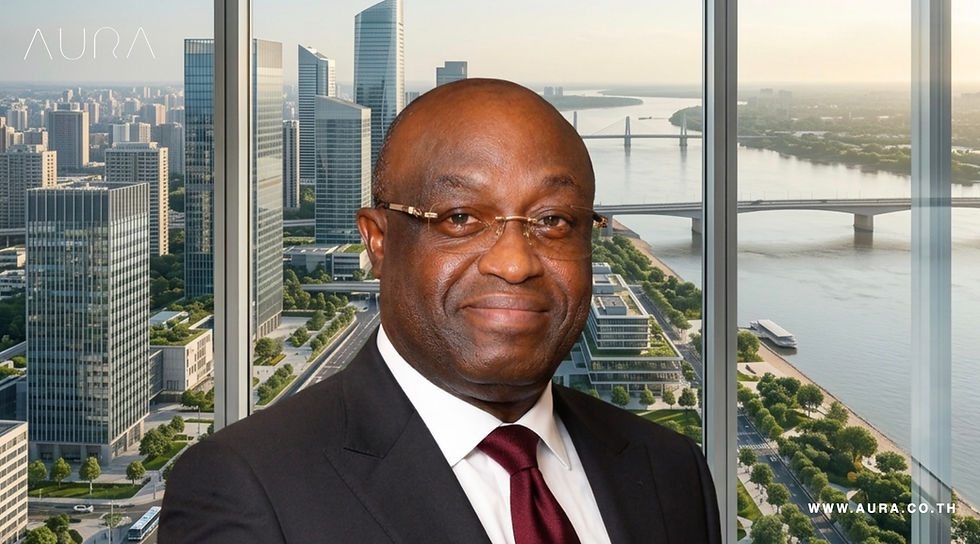
The decision to examine the Republic of the Congo from this broader perspective was significantly influenced by SEM Kouakou Adou Antoine, President of Aura SA (Congo).Antoine played an important role in presenting the Congolese proposition to Aura and encouraging the organisation to consider the country beyond its present economic statistics. His contribution was particularly important because the discussion could have been limited to the current size of the Congolese economy, its existing market and its immediate investment opportunities.
Instead, Antoine encouraged Aura to consider a longer-term proposition: what could the Republic of the Congo become if capital, infrastructure, technology, entrepreneurship, finance and human development were considered together over several generations?
That perspective changed the character of the discussion.
Antoine did not present Congo merely as another investment destination. He encouraged Aura to consider the country as a possible starting point for a broader Central African strategy. Pointe-Noire could be examined in the context of regional logistics and industrial development. Brazzaville could be considered within the wider commercial geography of Central Africa. The Congo River could be considered as part of a broader transportation and economic network. Natural resources could be viewed not only as commodities but also as potential foundations for processing and industrial development.Most importantly, Antoine encouraged Aura to examine what could be built rather than focusing exclusively on what already exists.
That distinction became significant in the development of Aura’s thinking about Congo.
Congo Is the Beginning, Not the Limit
Aura’s decision to begin in Congo should not be interpreted as a ranking of African countries.Africa’s major economies and emerging markets each have their own strategic characteristics. Nigeria possesses enormous population and economic scale. South Africa has sophisticated financial markets and established industrial capabilities. Egypt occupies a strategically important position connecting Africa, the Middle East and Europe. The Democratic Republic of the Congo possesses exceptional geographic scale and natural-resource potential. Morocco has developed significant industrial and logistical capabilities, while Kenya has established itself as an important commercial and financial centre in East Africa. Ghana, Angola, Côte d’Ivoire and other African economies likewise possess substantial opportunities.
Aura’s African investment vision is therefore not based on selecting one country at the expense of another.Congo is the starting point because of the particular combination of characteristics that attracted Aura’s attention and because of the role that Central Africa can potentially play in the continent’s long-term economic development.The starting point is therefore geographical, but the ambition is continental.
Understanding the USD 25 Trillion Vision
The proposed USD 25 trillion should be understood in the context of the exceptionally long time horizon associated with Aura’s African strategy. It is a long-term investment vision extending across generations rather than a conventional investment programme intended to deploy capital within a short or medium-term period.The potential scope encompasses infrastructure, energy, financial services, manufacturing, technology, telecommunications, transportation, logistics, ports, agriculture, healthcare, education, tourism, real estate, media and professional services.
The underlying principle is that Africa’s future economic development will require more than the acquisition of existing assets. It will require the creation of new productive capacity.
That means building infrastructure where infrastructure is required, developing businesses where new businesses can be supported, expanding industrial capacity, developing technology, improving logistics, increasing financial capacity and strengthening access to education and healthcare.
For Aura, investment therefore has a broader meaning than the purchase of an asset.
Capital can acquire existing economic capacity, but in the right circumstances it can also help create new capacity. The distinction is important for a strategy whose horizon extends beyond a single investment cycle.
Investment in People
Ultimately, however, the most important component of any long-term economic strategy is human capital.Infrastructure can be built and companies can be established, but the sustainability of an economy depends upon the people who operate its institutions, develop its businesses, manage its infrastructure and create new enterprises.
This is particularly relevant on National Youth Day.
Africa’s young population represents one of the continent’s most significant long-term economic opportunities. The economic consequences of demographic growth will depend substantially on whether young people have access to education, professional opportunities, technology, employment and entrepreneurship.Aura therefore views its African ambition not solely through the value of assets or the financial returns generated by investments. It also considers the productive capacity that can develop around those investments.
Entrepreneurs require capital and markets. Graduates require professional opportunities. Engineers require infrastructure projects in which their expertise can be applied. Technology professionals require an environment in which companies can be established and scaled. African businesses require access to finance, infrastructure and regional markets if they are to expand beyond their domestic economies.
In this sense, the ultimate measure of a long-term investment strategy is not simply the value of the assets created. It is also the economic activity, businesses, employment, skills and opportunities created around them.
The Wider Central African Opportunity
The Republic of the Congo also provides Aura with an opportunity to consider the broader economic potential of Central Africa.The region possesses significant natural resources and important geographic advantages, but its development has also been constrained by infrastructure gaps, limited connectivity and insufficient integration between resources, industry, logistics and financial systems.
This creates a wider strategic question for investors.
If infrastructure, energy, transportation, logistics, finance, technology and industry can be developed in greater coordination, can Central Africa capture a larger share of the economic value generated from its own resources and geographic position?
Aura believes this question deserves serious consideration.
Such development cannot be achieved through a single investment or institution. It requires long-term capital, strategic planning, business development, infrastructure and cooperation among governments, companies, financial institutions, entrepreneurs and communities.
For Aura, the Republic of the Congo is where that conversation begins.
The Individual Who Helped Start the Conversation
The history of Aura’s African chapter should therefore distinguish clearly between two things: responsibility for the investment vision and the individual contribution that helped bring Congo into that vision.The capital is Aura’s. The investment decisions are Aura’s. The responsibility for the strategy rests entirely with Aura.But the individual who first encouraged Aura to examine the Republic of the Congo from a different perspective was SEM Kouakou Adou Antoine.
His contribution went beyond introducing Aura to Congo. He helped change the framework through which Aura considered the country.
Rather than presenting Congo primarily through its current limitations, Antoine encouraged Aura to consider its future possibilities: its geographic position, access to the Atlantic, relationship with the Congo River, natural resources, infrastructure requirements, regional importance and human potential.
That perspective helped move the discussion from a conventional country-level investment assessment toward a much broader consideration of what could potentially be built over several decades.What began as a conversation about the Republic of the Congo subsequently developed into a broader consideration of Central Africa and became an important part of Aura’s continental African investment vision.
That contribution deserves explicit recognition.
A Long-Term African Vision
Aura’s USD 25 trillion African investment vision is ultimately based on a simple but consequential premise: economic potential should not be measured solely by what exists today.For a strategy extending across generations, the more important consideration is what can be built, developed and connected over time.The Republic of the Congo provides the starting point because of the combination of geography, natural capital, regional relevance and development potential that first attracted Aura’s attention. Central Africa provides a broader context. Africa as a whole represents the ultimate horizon.
Aura does not regard the journey as a single transaction, a single project or a single investment cycle. It is a long-term proposition concerning infrastructure, industries, businesses, financial capacity, technology and, most importantly, people.
On National Youth Day, that final point carries particular significance.
The future of the Republic of the Congo will ultimately be determined not simply by the resources beneath its soil or the infrastructure constructed across its territory, but by the people who build businesses, develop institutions, create technology, operate industries and shape the country’s economic future.
Aura extends its sincere respect and best wishes to the Republic of the Congo and to its young generation on National Youth Day.
The investment vision may begin in Congo, but its purpose is to participate in building the economic capacity of a more connected and prosperous Africa for generations to come.


Comments