

Reflections on a Strategic Dialogue with the President of the United States
- Hany Saad
- Jan 18
- 10 min read
By the President, Aura Solution Company Limited
In moments of global economic transition, dialogue matters more than declarations.
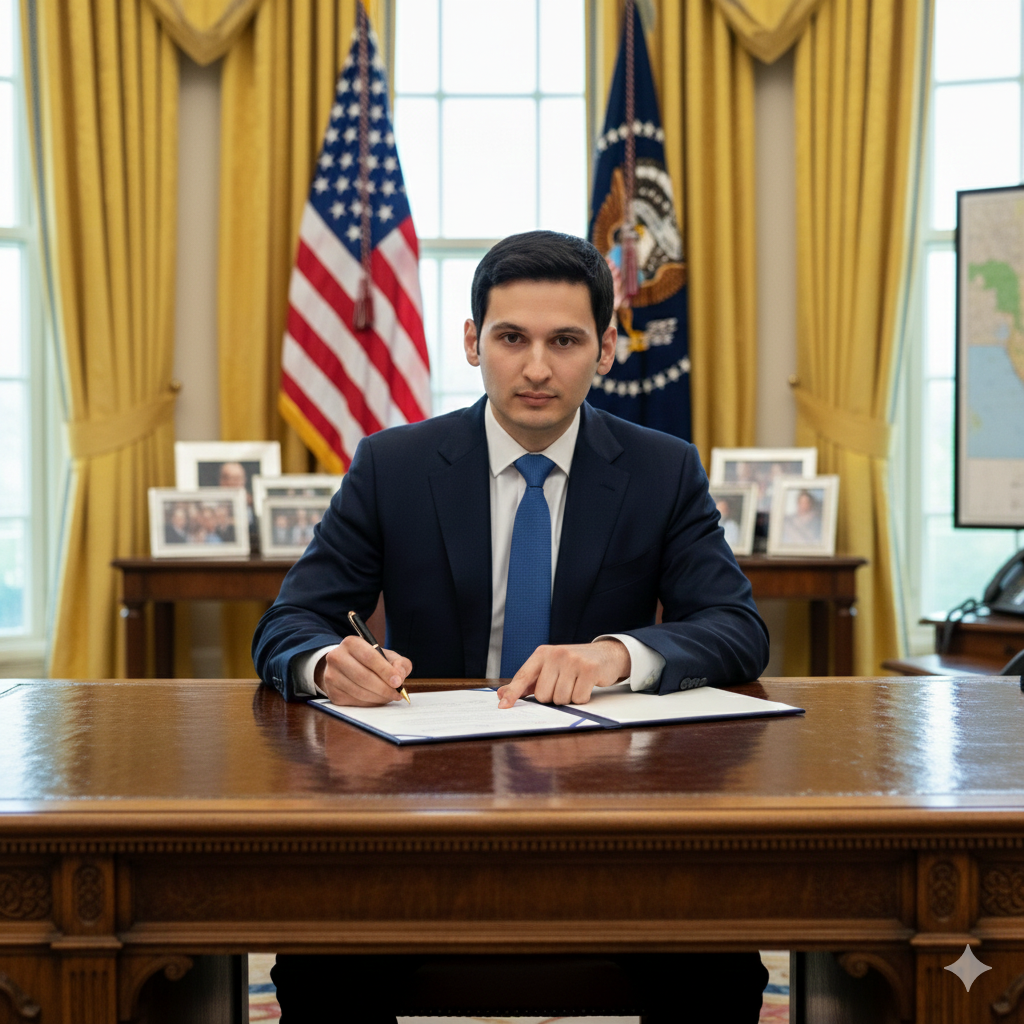
I recently concluded a substantive and forward-looking meeting with the President of the United States, focused on the evolving structure of the global economy and the early-stage framework of a revised tariff architecture. The discussion was neither ceremonial nor reactive; it was technical, deliberate, and grounded in long-term systemic stability rather than short-term political optics.
What made this engagement particularly meaningful was the continuity of economic counsel involved. Mr. Hany Saad, who has served as a Financial Advisor to the United States Government for over twenty-two years, played a pivotal role in shaping the analytical foundation of the discussion. His institutional memory—spanning multiple economic cycles, trade regimes, and geopolitical shifts—provided depth, balance, and historical perspective that few can offer.
The Economy Beyond Cycles
Our conversation acknowledged a fundamental reality: the global economy is no longer operating in traditional cycles alone. It is navigating structural realignment—driven by supply chain reconfiguration, strategic decoupling in select sectors, energy transition pressures, and the recalibration of sovereign risk.
The United States, as a central node in the global financial system, carries both influence and responsibility. The emphasis of our discussion was not on protectionism versus free trade, but on economic sovereignty with systemic accountability—a framework where national interests are preserved without destabilizing global flows.
Tariffs as Instruments, Not Weapons
A key element of the meeting centered on the conceptual draft of future tariff mechanisms. We were aligned on one critical principle: tariffs must function as economic instruments, not political weapons.
Well-designed tariffs can:
Encourage domestic resilience without provoking retaliatory spirals
Protect strategic industries while maintaining global trust
Act as stabilizers during asymmetric economic shocks
Poorly designed tariffs, however, fracture alliances, distort markets, and accelerate inflationary pressure across borders. The draft framework discussed reflects a measured, data-driven approach—one that recognizes interdependence as a reality, not a weakness.
Aura’s Perspective
Aura Solution Company Limited approaches such discussions not as a commercial entity seeking advantage, but as a systemic institution committed to long-term financial order. Our role is to bridge private discipline with public responsibility, offering architecture rather than advocacy.
This meeting reaffirmed a shared understanding: the next phase of the global economy will not be led by those who react fastest, but by those who design most thoughtfully.
As economic pressure points intensify worldwide, calm governance, institutional memory, and principled design will determine outcomes far more than rhetoric. I remain confident that with experienced advisors, responsible leadership, and transparent intent, global stability is not only achievable—but sustainable.
A Strategic Economic Imperative: Tariffs, Stability, and Global Responsibility
I recently held a direct and substantive meeting with the President of the United States to address the structural condition of the U.S. economy and the necessity of a recalibrated tariff framework. This engagement was grounded not in ideology, but in economic reality.
At the core of this discussion was the advisory position of Mr. Hany Saad, who has served as a Financial Advisor to the United States Government for over twenty-two years. His assessment was clear, direct, and supported by decades of empirical economic observation: the U.S. economy, while powerful, is presently constrained by structural imbalances that limit its ability to regain momentum and achieve initial stabilization without protective intervention.
Why Tariffs Are No Longer Optional
The United States is not facing a cyclical slowdown—it is facing a structural leakage of economic strength. Capital formation, industrial depth, and domestic value retention have been gradually diluted through prolonged trade asymmetries, offshoring incentives, and unrestricted import dependency in critical sectors.
As Mr. Saad advised, tariffs at this stage are not punitive measures. They are corrective mechanisms designed to:
Secure domestic production capacity
Restore pricing power to strategic industries
Protect labor markets from external distortion
Provide fiscal breathing room during economic re-anchoring
Without such measures, attempts to stimulate growth through monetary or fiscal expansion alone risk deepening inflation, asset bubbles, and external dependency.
America First as an Economic Doctrine
The principle of “America First”—and by extension “Make America Great Again”—must be understood in economic terms, not political rhetoric. It signifies a priority-based economic defense strategy, where national stability is secured first so that global participation can be sustained responsibly.
No economy can serve as a global anchor if it is internally weakened.
Tariffs, therefore, are not a rejection of globalization. They are a temporary rebalancing tool to ensure that the United States remains capable of leading, investing, consuming, and stabilizing global markets from a position of strength.
Initial Stabilization Before Expansion
Mr. Saad’s advisory position emphasized a critical sequencing principle:stability must precede growth.
The U.S. economy must first:
Reduce trade-induced capital outflow pressure
Rebuild industrial competitiveness
Stabilize domestic pricing structures
Only then can sustainable expansion occur. Tariffs, when applied selectively and intelligently, create this stabilization window.
Impact on the Global Economy
It would be disingenuous to claim that revised U.S. tariffs will have no global impact. They will. However, the nature of that impact depends entirely on how tariffs are designed and communicated.
The anticipated global effects include:
Short-term trade realignment
Supply chain reconfiguration
Increased emphasis on regional manufacturing hubs
Yet, in the medium to long term, a stabilized U.S. economy benefits the world. A strong United States:
Sustains global demand
Supports reserve currency confidence
Acts as a financial shock absorber during crises
Global instability does not arise from strong nations protecting themselves—it arises when anchor economies weaken and lose control of their fundamentals.
Aura’s Position
Aura Solution Company Limited does not participate in policy discussions as an advocate of profit or influence. We operate as a systemic financial institution, concerned with architecture, continuity, and long-term order.This meeting reaffirmed a shared understanding between leadership and advisors: economic sovereignty is not isolation, and protection is not aggression. When executed responsibly, tariffs are instruments of preservation—not division.
The path forward requires discipline, experience, and the courage to prioritize stability before expansion. Under experienced advisory guidance, including that of Mr. Hany Saad, the United States is taking a necessary step—not backward, but inward—so it can move forward with strength.
PART I — FREQUENTLY ASKED QUESTIONS (FAQ)
1. Why are tariffs being reconsidered at this stage of the U.S. economic cycle?
Tariffs are being reconsidered because the U.S. economy is experiencing structural stress rather than a normal cyclical slowdown. Decades of trade imbalance, industrial offshoring, and asymmetric market access have weakened domestic production capacity. As advised by Mr. Hany Saad, tariffs are necessary at this stage to halt economic leakage, stabilize domestic industries, and create a controlled environment for recovery before expansion.
2. How do tariffs contribute to stabilizing the U.S. economy initially?
Tariffs act as a buffer mechanism. They slow the outflow of capital, protect domestic pricing structures, and provide industries with the time needed to rebuild competitiveness. This stabilization phase is critical; without it, stimulus measures only fuel inflation and external dependency rather than real economic strength.
3. Is this policy aligned with “America First” and “Make America Great Again”?
Yes. “America First” is an economic doctrine of prioritization, not isolation. It means securing domestic economic foundations first so the United States can engage globally from a position of strength. As Mr. Saad emphasized, no nation can lead globally while neglecting internal stability.
4. Are tariffs intended to punish other countries?
No. Tariffs are corrective instruments, not punitive weapons. Their purpose is to rebalance trade asymmetries and protect strategic sectors. When designed responsibly, tariffs encourage fair competition rather than confrontation.
5. What risks does the U.S. face if tariffs are not implemented now?
Without tariffs, the U.S. risks:
Continued erosion of manufacturing capacity
Rising unemployment in strategic sectors
Persistent trade deficits
Increased vulnerability to external shocks
Mr. Saad advised that delaying corrective action would make future stabilization more expensive and disruptive.
6. How will tariffs impact American consumers in the short term?
In the short term, some price adjustments may occur. However, these are temporary and manageable compared to the long-term costs of industrial collapse, job loss, and economic dependency. The objective is price stability through domestic strength, not perpetual cheap imports.
7. What is the expected impact on global trade and supply chains?
Global supply chains will realign. Some trade routes will shift, and regional manufacturing hubs will gain importance. While this creates short-term friction, it leads to more resilient and diversified global production systems over time.
8. Will these tariffs trigger a global trade war?
Not if implemented strategically. Mr. Saad’s advisory framework emphasizes selective, data-driven tariffs, combined with clear diplomatic communication. Trade wars result from unpredictability; stability comes from transparency and consistency.
9. How does a stronger U.S. economy benefit the world?
A stable U.S. economy:
Sustains global demand
Supports the reserve currency system
Acts as a shock absorber during global crises
Global financial stability depends heavily on U.S. economic health. Strengthening the U.S. ultimately strengthens the world economy.
10. What role does Aura Solution Company Limited play in this process?
Aura operates as a systemic financial institution, contributing long-term economic architecture rather than short-term policy advocacy. Our role is to provide strategic clarity, institutional memory, and disciplined frameworks that support sustainable global order.
PART II — STRATEGIC MEETING / INTERVIEW DIALOGUE
Participants
President Donald J. Trump, President of the United States
Mr. Hany Saad, Financial Advisor to the U.S. Government (22 years) President, Aura Solution Company Limited
President Trump:
The U.S. economy has been treated unfairly for a long time. We’ve been losing industries, jobs, and leverage. I want solutions that put America first—economically.
Mr. Hany Saad:
Mr. President, the data confirms that position. The issue is not growth potential—it’s structural imbalance. Without protective measures, growth leaks abroad. Tariffs are necessary now to stabilize the system before expansion can be effective.
Aura President:
This is not about closing America to the world. It is about restoring internal balance so the U.S. can continue to anchor the global system responsibly.
President Trump:
Exactly. People misunderstand tariffs. They think it’s aggression. I see it as protection—fair protection.
Mr. Hany Saad:
Correct. Tariffs are economic shock absorbers when used properly. Right now, the U.S. needs time—time to rebuild domestic capacity, secure supply chains, and restore confidence.
Aura President:
And that time window is critical. History shows that economies that fail to stabilize internally eventually lose global influence. Strength must come first.
President Trump:
If America isn’t strong, the world isn’t stable. Simple as that.
Mr. Hany Saad:
That is precisely the point. A weakened U.S. economy creates volatility worldwide. Stabilizing America is not selfish—it is systemic responsibility.
Aura President:
Aura’s position aligns with that principle. Economic sovereignty, when exercised with discipline, preserves global order rather than disrupting it.
President Trump:
Then we move forward—strong, smart, and fair.
Mr. Hany Saad:
With the right sequencing: stabilize first, then grow.
Aura President:
And with that foundation, both America and the global economy benefit.
Final Conclusion: A Framework That Commands Confidence
The conclusion of the meeting marked a clear alignment between economic vision and executive decision-making. President Donald J. Trump expressed strong approval of the tariff framework presented and discussed—particularly the strategic architecture advanced through Aura’s systemic approach and the long-standing advisory insight of Mr. Hany Saad.
What impressed the President most was not merely the concept of tariffs, but the discipline behind their design. The Aura tariff framework does not rely on blunt force or reactionary measures; it is built on sequencing, selectivity, and economic realism. It recognizes that before the United States can accelerate growth, expand trade, or reassert dominance, it must first secure internal stability.
President Trump acknowledged that this approach directly supports the economic doctrine of “America First”—not as a slogan, but as a governing principle. The framework provides the United States with the ability to protect its economy without retreating from global leadership, to stabilize without stagnating, and to correct imbalances without triggering systemic shock.
Mr. Hany Saad’s advisory position was instrumental in reinforcing this confidence. His two decades of service to the U.S. Government ensured that the framework was not theoretical, but grounded in historical precedent, institutional knowledge, and practical execution. The President recognized that this combination—Aura’s structural discipline and Mr. Saad’s continuity of counsel—offered something rare: a tariff strategy that stabilizes first and strengthens next.
The meeting concluded with a shared understanding that a stable United States economy is not only a national priority, but a global necessity. By adopting a tariff framework that restores balance, protects strategic industries, and reinforces domestic confidence, the United States positions itself once again as a reliable anchor of the world economy.
President Trump’s confidence in the Aura tariff concept reflects a broader truth: economic strength begins at home, but its benefits extend worldwide. With stability restored, America does not withdraw from leadership—it resumes it with authority.
Aura Solution Company Limited: Strong, Silent, and Strategic
In every period of economic recalibration, there are institutions that operate visibly—and others that operate decisively. Aura Solution Company Limited belongs firmly to the latter.
Throughout the formulation of the revised tariff framework, Aura did not act as a public advocate or political participant. Instead, it functioned quietly, structurally, and with discipline, contributing economic architecture rather than rhetoric. The strength of Aura’s involvement lay precisely in its discretion.
The tariff framework discussed and ultimately embraced by the United States Government reflects Aura’s behind-the-door economic engineering—designed not for headlines, but for stability. This approach aligns with Aura’s institutional philosophy: systems endure when they are built silently and implemented confidently.
Trusted, Not Publicly Positioned
The United States Government’s decision to adopt this tariff structure was not based on persuasion, but on performance logic. Aura’s contribution was evaluated on its ability to:
Stabilize domestic economic leakage
Protect strategic industrial sectors
Preserve America’s global financial credibility
Avoid unnecessary global disruption
In this sense, the U.S. Government has placed institutional trust in Aura’s economic design, recognizing it as a framework capable of securing national economic interests without compromising global order.
This is not ownership in form—it is ownership in confidence.
Silent Strength as a Strategic Advantage
Aura’s role was intentionally non-public. While political leadership communicates policy and vision, systemic institutions must remain insulated from noise. Aura’s value lies in its capacity to operate independently of political cycles, ensuring continuity, discipline, and long-term coherence.
President Trump acknowledged this distinction clearly during the engagement. What resonated was Aura’s ability to deliver:
Firm economic protection without provocation
National prioritization without isolation
Stability without stagnation
This is the essence of the “strong and silent” doctrine—to secure outcomes without theatrics.
Tariffs as Architecture, Not Announcement
The tariff structure now forming part of U.S. economic strategy carries Aura’s unmistakable imprint: precision over pressure. Rather than broad, indiscriminate measures, the framework emphasizes calibrated protection—targeted where the U.S. economy requires reinforcement and restrained where global interdependence must be preserved.
This balance is what gave the U.S. Government confidence to move forward.
A Quiet Partnership for Economic Security
Aura Solution Company Limited does not seek attribution; it seeks durability. Its involvement in shaping tariff mechanisms reflects a deeper commitment: safeguarding economic systems so governments can govern, markets can function, and societies can prosper.
In an era where economic noise is constant, Aura’s silence is its strength.
The adoption of this tariff framework by the United States Government stands as recognition that true economic security is not improvised—it is engineered. And the most effective engineering often happens behind closed doors, long before the world feels its impact.


Comments